
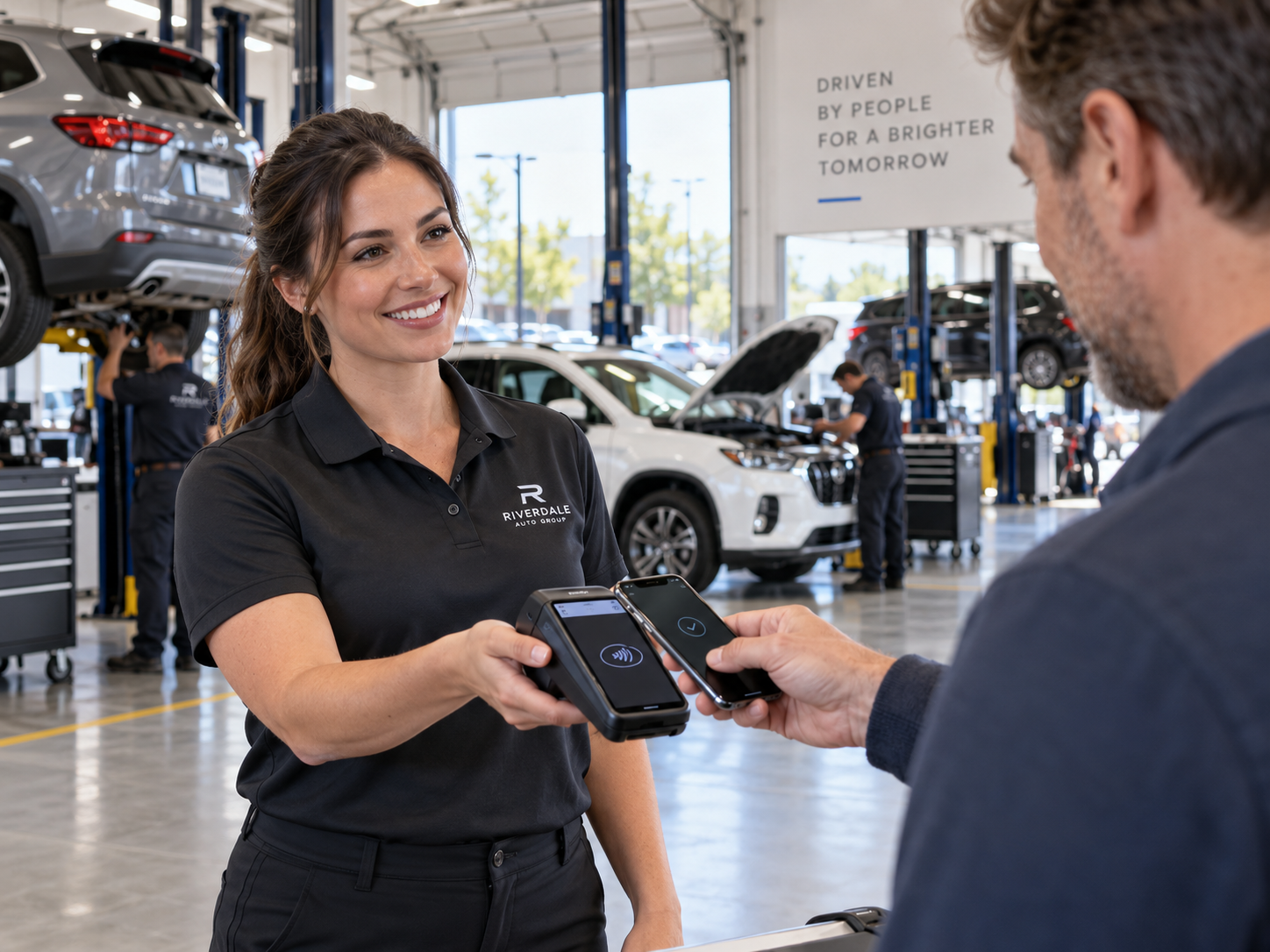
Not every transaction happens at your cashier window. Mobile service calls. Wholesale parts deliveries. Curbside pickup. A customer who swings by after hours and never sees the front desk. Every one of those moments still needs to end the same way: you get paid, cleanly and fast.
Most dealerships weren’t built for that. The payment process still assumes someone’s standing at a counter with a card reader in front of them. Everywhere else, teams fall back on cash, paper invoices, and checks, and that patchwork creates real problems.
What cash and checks actually cost you
Ask any dealership running a mobile parts or service operation and you’ll hear the same list.
Drivers carrying cash become an accounting function on wheels. They’re expected to repair vehicles or deliver parts, then also track invoices, collect payment, and keep it all organized in a moving vehicle. That’s not what you hired them to do, and it’s not what they’re good at.
Checks bring their own drag. A check can sit for three or four days before you find out it’s no good. By the time it bounces, your admin team is calling the shop, arranging a replacement, and waiting another week for a new one to arrive, or sending a driver back out on an extra stop just to collect it.
Then there’s safety and loss. Cash goes missing. Sometimes you know why. Often you don’t, and that’s its own uncomfortable conversation with your team.
None of this shows up as one big dramatic number. It shows up as staff hours spent reconciling, drivers doing work they shouldn’t have to do, and the occasional transaction that just evaporates.
How one dealer group solved it
Niello Auto Group runs 10 dealership rooftops and a body shop out of the Sacramento region, with a wholesale parts delivery operation that covers the Bay Area, the Central Valley, and into western Nevada. Fourteen delivery vehicles run those routes daily.
For years, that meant drivers running invoices with cash and checks in hand. When Niello moved to Dealer Pay, the fix was straightforward: give drivers a mobile app that lets them collect payment on the spot, tied directly to the invoice or customer account, no separate hardware and no manual entry later.
The same shift happened in the service lane. Instead of a handoff from advisor to cashier, where a customer’s simple question could turn into confusion because the cashier doesn’t know the repair details, the advisor now completes the transaction directly. One person, one conversation, and the customer’s on their way.
The result Kris Towle, Head Controller at Niello, pointed to wasn’t a single big metric. It was speed and visibility. Funds that used to wait a day or two for deposit now land in the bank the next morning. Every transaction shows exactly who ran it, down to the device, whether it came from a driver in the field or an advisor at the counter. Staff who used to spend their day collecting and chasing payments are doing higher-value work instead.
See it in action: Kris Towle and Travis Siebert, SVP at Dealer Pay, walked through this exact transition on the Car Dealership Guy podcast, from drivers carrying cash and checks to a fully mobile payment workflow. Watch the full episode.
Why this works: payments built into your DMS, not bolted on
A generic processor can hand you a card reader. It can’t tell you which repair order a mobile payment belongs to, or route it automatically into your accounting system. Dealer Pay is built exclusively for dealerships, which means every payment, whether it’s run from a service bay, a sales desk, or a driver’s phone in a parking lot three counties away, flows straight into your DMS and locks to the right deal jacket, RO, or customer record.
That connection is what turns mobile payments from a nice-to-have into real operational leverage:
- Reconciliation happens automatically. No batching receipts at the end of the day, no manual matching of payments to invoices. Dealers using Dealer Pay cut 10-20 staff hours a month on average, time that used to go to exactly this kind of cleanup.
- Transactions run in about 10 seconds, whether it’s a tap-to-pay on a phone, a terminal in the service lane, or an in-app Apple Pay transaction out in the field.
- Compliant surcharge and cash-discount programs pass along up to 3% of your processing fees and reduce surcharge pricing by 75-80%, so the fees your dealership has already absorbed start coming back.
- Security is handled, not managed. End-to-end encryption, tokenization, PCI-DSS certified terminals, and automated surcharge compliance mean your team isn’t the last line of defense against a payment mistake.
What to look for if you’re still collecting cash and checks in the field
If your mobile service or parts operation still runs on paper invoices and whatever payment method the customer has on hand, a few questions are worth asking before you pick a solution:
- Does it integrate with your DMS directly, so payments land on the right RO or deal without someone re-keying them?
- Can it handle every payment type your customers actually use, including Apple Pay and other mobile wallets?
- Will the vendor actually show up? Onsite training, hands-on chargeback support, and someone who answers the phone when a terminal goes down matter more than a feature list once you’re live.
- Does it give you a clear audit trail, so you know exactly who ran a transaction and when, without guessing?
Dealer Pay was built by people who’ve lived inside dealership operations, which is why it answers all four. Every dealer. Every dollar.
Ready to see what mobile and remote payments look like with Dealer Pay? Book a demo and we’ll walk through what it’d look like on your service lane and in the field.