
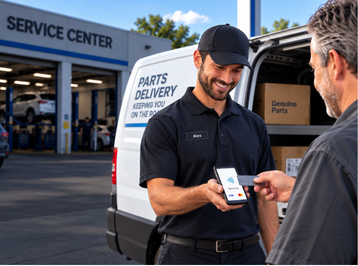
Dealership service is no longer confined to the service lane. From mobile service appointments and vehicle delivery to remote payments and contactless checkout, customers increasingly expect convenience at every stage of their dealership experience.
But while dealerships have expanded where they serve customers, their payment processes haven’t always kept pace.
A service advisor may close a repair order (RO) beside a customer’s vehicle. A driver may collect payment during delivery. A customer may want to settle a bill from home before returning to pick up their vehicle. Each scenario moves the transaction beyond the traditional cashier window.
Without the right technology, however, these conveniences can create additional work for dealership staff, introduce reconciliation challenges and disconnect payments from the records accounting relies on.
The opportunity isn’t simply to accept payments anywhere. It’s to complete the entire transaction wherever the customer is.
Meet Customers Wherever They Are
As dealerships expand their services beyond traditional locations, payment flexibility is becoming an increasingly important part of the customer experience.
Ford reported in 2026 that approximately one in seven Ford service visits occurred at a customer’s home or office, based on its 2025 U.S. data. As off-site service becomes more common, requiring customers to visit the dealership separately to pay undermines the convenience of the service itself.
Flexible payment options can support several dealership departments:
- Service: Advisors can collect payment beside a customer’s vehicle, eliminating an additional stop at the cashier.
- Pickup and delivery: Drivers can accept payments at a customer’s home or workplace.
- Parts: Employees can collect payments from wholesale customers away from the counter.
- Sales and F&I: Dealership employees can collect agreed payments during vehicle delivery.
For customers who prefer to pay remotely, secure payment links provide another convenient option. Portable payment terminals allow employees to accept payments wherever they meet customers.
Regardless of where the transaction takes place, employees need access to accurate payment information and immediate confirmation. Service workflows should also allow customers to sign repair orders and receive receipts without returning to the dealership.
Eliminate the Checkout Bottleneck
A positive dealership experience shouldn’t end with a frustrating checkout process.
According to Cox Automotive’s April 2026 research summary, 24% of dealership service customers who reported a frustration said their visit took too long. J.D. Power’s 2026 U.S. Customer Service Index Study also identifies vehicle pickup as the second-most-important factor among its five measures of service satisfaction, behind service quality.
These findings highlight the importance of the final customer interaction. Even when service goes smoothly, waiting for an available cashier, traveling to another department or completing additional paperwork can add unnecessary friction.
Mobile payment technology can help dealerships simplify checkout by allowing employees to complete transactions where customers are already located. For example, a service advisor equipped with a portable terminal can review the final invoice, collect payment and complete the transaction beside the customer’s vehicle.
To deliver this experience consistently, dealerships should consider equipment reliability, battery life, connectivity and the ability to capture signatures and provide receipts. The objective is to eliminate unnecessary steps while maintaining accurate transaction records.
Why DMS Integration Matters
Accepting a payment is only one part of the transaction. What happens afterward can have an equally important impact on dealership efficiency.
A mobile terminal may allow an employee to collect payment anywhere, but if the transaction doesn’t connect to the dealership management system (DMS), the time saved at checkout can quickly become additional work for accounting.
Without integration, dealerships may encounter several operational challenges:
- Duplicate data entry: Employees must manually record transactions in the DMS after collecting payment.
- Disconnected records: Payments may arrive without clear references to the associated customer, repair order, parts ticket or deal.
- Time-consuming reconciliation: Accounting teams must track transaction details or contact employees to resolve discrepancies.
- Incomplete documentation: Signed repair orders and receipts may be stored separately from the original transaction.
A connected payment solution helps eliminate these inefficiencies by keeping transactions tied to the dealership’s existing workflows. For service transactions, that means collecting payment, capturing a signed repair order and maintaining accessible records for the office.
Dealerships evaluating mobile payment providers should request a demonstration of the entire process, from accepting payment through posting the transaction to the DMS. They should also understand how the system handles exceptions, including situations in which a payment succeeds but the transaction fails to post correctly.
The goal is to prevent a convenient customer interaction from creating unnecessary administrative work behind the scenes. When evaluating payment solutions, dealerships should look beyond processing rates and consider the operational costs of manual data entry, disconnected records and time-consuming reconciliation.
Protect Every Transaction
Moving payments beyond the cashier window introduces additional considerations for security, employee access and transaction management. Whether an employee is accepting payment in the service lane or at a customer’s home, the dealership needs consistent processes for protecting customer information.
- Secure card-data handling: Can customers pay without employees recording card information in notes, text messages or emails?
- Employee permissions: Can the dealership control access to transaction records, refunds and other sensitive functions?
- Device security: What protections are available if a portable payment terminal is lost or stolen?
- Transaction visibility: Can employees confirm whether a payment succeeded before attempting another transaction?
The payment method itself can also affect processing costs and fraud exposure. For in-person transactions, portable terminals supporting chip and contactless payments allow customers to use card-present methods. Properly processed EMV transactions may also provide protection against certain types of counterfeit-card fraud.
Remote payment links offer convenience when customers aren’t physically present, but their processing costs and fraud considerations may differ. Dealerships should evaluate each payment method based on intended use, applicable costs and security controls rather than assuming one method suits every transaction.
What to Look for in a Mobile Payment Solution
Before investing in mobile payment technology, dealerships should evaluate how well the solution supports existing operations and customer experience goals.
- Can employees accept payments wherever customers are? Evaluate mobile terminals and secure links for service lanes, delivery, off-site appointments and remote transactions.
- Does the solution integrate with your DMS? Confirm whether payments connect to the correct repair orders, parts tickets or deals without duplicate entry.
- Can customers complete the entire transaction remotely or on the go? Look for digital signatures, signed repair orders, receipts and immediate confirmation.
- How does the solution protect transactions? Review security controls, employee permissions, supported methods and interrupted-payment procedures.
- Will it simplify reconciliation and improve visibility? Ask how records are maintained, status is communicated and exceptions are resolved.
The Future of Dealership Payments Is Connected
As mobile service, vehicle delivery and remote customer interactions evolve, dealerships need payment technology supporting the entire transaction, not just the moment a customer pays.
The right solution should make checkout more convenient while helping teams eliminate duplicate entry, maintain accurate records and simplify reconciliation. Mobile payments should extend existing dealership workflows beyond the cashier window, not create separate processes employees must manage later.
The real measure of mobile payment technology is whether a dealership can complete a transaction wherever it begins while keeping payments, documentation and accounting connected.
Take Your Dealership Payments Beyond the Cashier Window
Discover how Dealer Pay can help connect your dealership’s payment experience with the workflows your team relies on. Schedule a conversation with our payment experts to explore your dealership’s needs.